

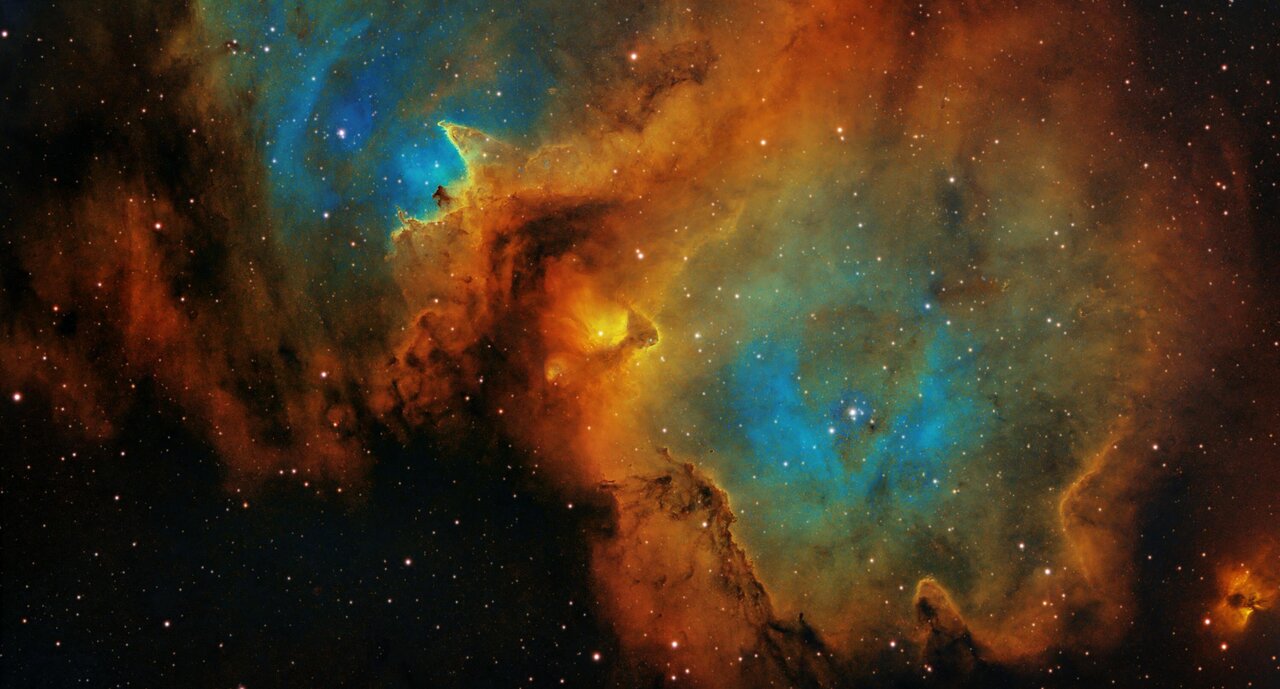
Hyperspace as in quantum science • Vedic Concept
The Nasadiya Sukta (Rigveda 10.129.1-2) is the myth of the first moments in existence — perhaps the earliest known cosmology that resonates with modern quantum field theory.
“Then, there was neither existence nor non-existence,
Nor was there air, nor the sky beyond.
What covered it, and where? Who knows?
There was neither death nor immortality,
Nor was there any distinction of night or day.
That One (Tat Ekam) breathed, windless, by its own power.”
What this means:
In the beginning, there was nothing—not even time, space, or matter. Only Param Brahmam, the infinite formless source, existed. There was a state of total voidness, yet containing all possibilities of creation.
This is not a mere emptiness, but a plenum of potential—the quantum ground state from which all universes arise.
Tat Ekam — “That One” — breathes without wind, self-sustained. This is not a void, but a formless quantum potential: an eternal field where existence and non-existence are yet to separate. Modern physics calls it the quantum vacuum, the hyperspace of infinite possibility. The seers called it Param Brahmam.
— The beginning that has no beginning · Param Brahmam
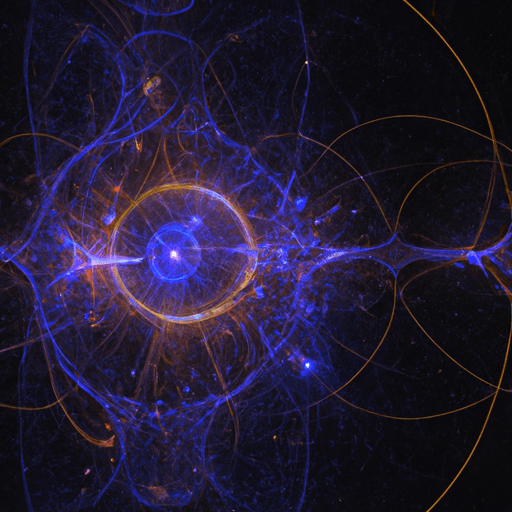
Science Connection:
According to string theory, there cannot be absolute empty space. Let us forget our perception that something is difficult to create, as the opposite is true. There shall forever be something, and nothing is hard to produce. This state is known as hyperspace—a state before the Big Bang, the Param Atmam.
2.OM: The Creative Sound
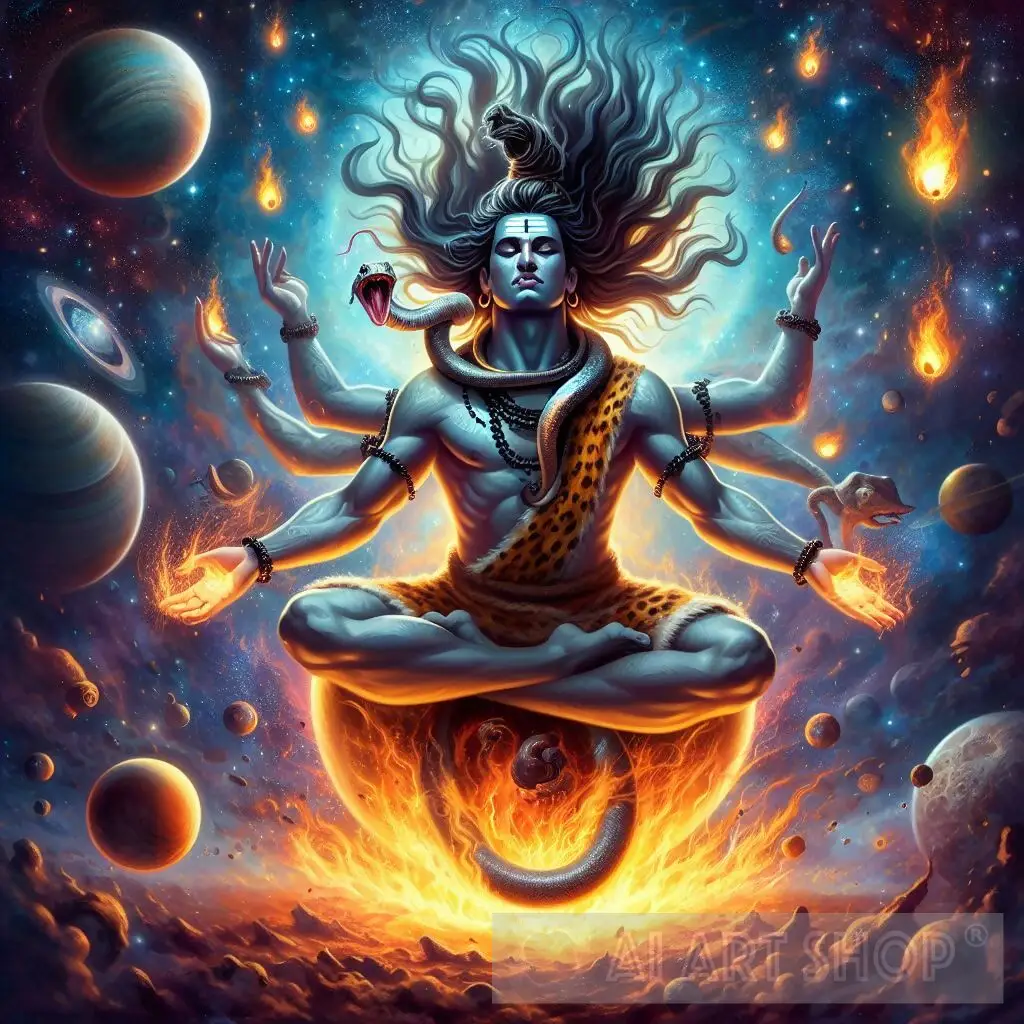
OM · the vibration that became the cosmos
The Mandukya Upanishad speaks of OM as the imperishable sound — the rhythm that weaves creation and destruction, much like waves in a cosmic ocean.
“OM is the imperishable sound,
The past, present, and future,
And that which transcends time itself.”
What this means:
OM is the vibration that began and sustains the universe. It represents the rhythm of creation and destruction, much like waves in a vast ocean. This vibration — or cosmic string — transforms Param Brahma (the formless) into Nara (the cosmic ocean), giving rise to the ultimate consciousness: Narayana.
Thus, the universe is not silent: it hums with an eternal, creative vibration.
Science connection:
In string theory, the fundamental building blocks of the universe are tiny vibrating strings. These vibrations determine the nature of particles — how they interact, their mass, their very existence — similar to how OM shapes the universe.
Moreover, the gravitational waves detected from the Big Bang provide direct evidence of the universe’s first vibrations. The cosmos began with a primordial tremor — a scientific echo of the primal sound.
Vibration is the language of reality, from the smallest string to the largest galactic wave.
— The rhythm of creation · OM · string theory · gravitational waves
3.NARAYANA: THE FIRST CONSCIOUSNES
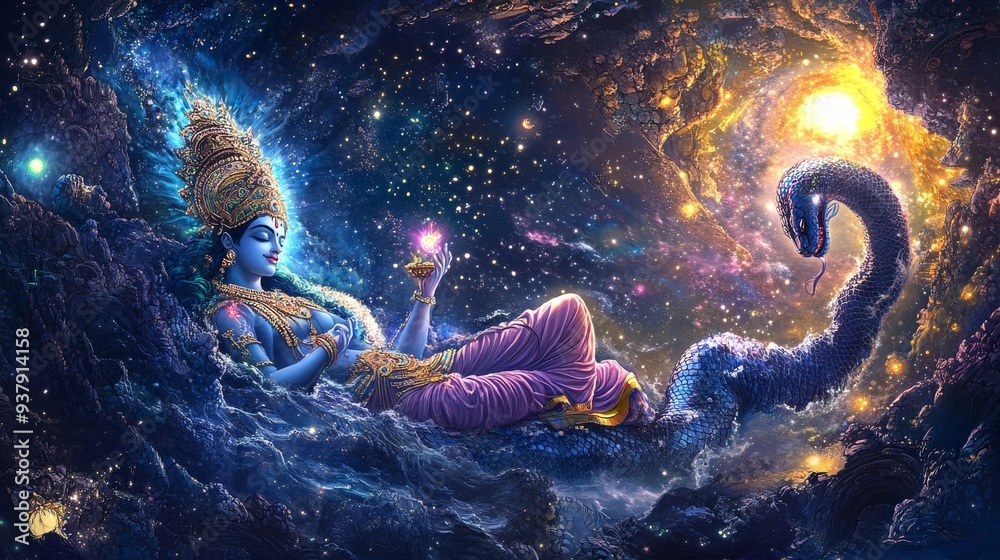
Narayana · the first spiritual mind
The Bhagavata Purana describes the primordial moment when consciousness stirred the cosmic waters — the birth of manifest reality.
“Narayana is the ultimate spirit, the basis of all manifestation.
Through His will, the cosmic waters stirred, and the process of creation began.”
What this means:
In the Vedic perception, Nara is the manifestation of the cosmic abodes — the union of Param Brahmam (the formless source) and OM vibration (the primal sound).
Narayana may be understood as the first spiritual mind in the cosmic ocean — the one who observes, and also the one who initiates. A conscious energy, difficult to fully identify, that turns the infinite into manifest reality by attributing consciousness to it.
Thus, Narayana is both the observer and the catalyst — the point where formless potential becomes aware of itself.
Modern parallel:
In quantum physics, the observer effect suggests that consciousness plays a role in collapsing probability into reality. Some philosophers propose a cosmic consciousness that pervades the universe — not unlike Narayana, the first mind that turns the infinite potential of Param Brahmam into a manifest cosmos.
The “cosmic waters” stirred by will may be seen as the quantum field responding to the first observation — the dawn of reality itself.
Consciousness is not a byproduct of the universe — it may be its source.
— The observer awakens · Nara · Narayana · cosmic consciousness
4.NASADIYA SUKTA: HEAT AS THE DRIVING FORCE (BIG BANG)
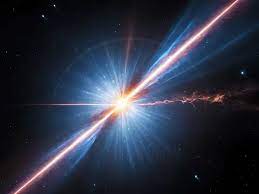
Tapas · the heat that ignited creation
The Nasadiya Sukta (Rigveda 10.129) describes a moment before existence — when heat (tapas) stirred and the universe flared into being.
“Non-existence wasn’t, yet existence wasn’t then.
Dust didn’t exist, nor did space beyond.
What moved back and forth? Where? In whose care?
Did water exist deep, impervious?
Death wasn’t, immortality wasn’t thence.
Day was not distinguished by the night.
Without breathing air, the one by power of self-establishment —
None else beyond that was.
Darkness it was, hidden by darkness, at the point.
Undistinguished, unsteady, all this was.
Hidden by nothing, coming to being, it was.
The one manifested by the greatness of heat.
At the point, passion evolved,
Over the thought, which was the first seed.
The bond of existence they found in non-existence:
The poets, seeking in heart, by wisdom.
Across was stretched, the cord.
What was below …? What was above …?
There were the great establishers of seed.
Self-establishment was beneath, Effort beyond.
Who really knows, who could here proclaim
When this has manifested — when — this release.
Towards are the devas, of this wide release.
(So) who really knows from where it has come to be!
This widespread release, as it would eventually become .
Or else if it was ‘established’, or else if not.
That is, he who watches over it in the upper realm .
Yes, it knows or at least he doesn’t know….”
What this means:
Here, heat (tapas) is described as the force that brought the formless into existence — the ignition of creation. It is the dense heat of small size that expands into all that is.
This primordial tapas is not merely physical temperature, but a cosmic creative intensity — the first stirring of potential into actuality, the spark that transforms “nothing” into something.
The verse captures both the mystery and the mechanism: by the greatness of heat, the One manifested.
Science connection — The Big Bang:
The Big Bang began as an infinitely hot, dense sphere of matter and energy. From this primordial fire, heat and energy drove matter into existence and space itself expanded.
The Vedic idea of tapas as the driving force aligns precisely with the scientific understanding that the early universe was unimaginably hot and dense — a state where physics as we know it begins with pure heat.
The seers called it tapas. We call it the Big Bang. Both point to the same truth: creation began with fire.
The dense heat of small size:
Just as the Rigveda describes the One manifesting “by the greatness of heat,” modern cosmology describes the singularity — an infinitesimally small point of infinite heat and density that expanded into our universe. The parallel is astonishing: heat as the midwife of existence.
— The fire before existence · tapas · Nasadiya Sukta · Big Bang
5. MULTIPLE UNIVERSES: SPARKS OF CREATION
Countless sparks · the multiverse of the Upanishads
The Brihadaranyaka Upanishad paints a vision of creation so vast that one universe could never contain it — an infinite fountain of worlds.
“As countless sparks arise from a blazing fire,
So do countless universes arise from Brahman,
The infinite and eternal source.”
What this means:
The infinite Param Brahmam has not just one universe, but many — countless universes as multiples. This is the Vedic vision of the multiverse.
Every universe is like a bubble that emerges from the cosmic sea, expanding and developing all by itself, each following its own course of evolution. The cosmic fire of Brahman continuously breathes out these world-sparks.
Just as sparks are not separate from the fire, these universes are not separate from their source — they are expressions of the same eternal, formless reality.
Bubbles in the cosmic sea:
Imagine an endless ocean. Bubbles form, expand, drift, and eventually dissolve — but the ocean remains. Each bubble is a universe, complete and self-contained, yet never separate from the water that gave it birth. This is the Vedic multiverse: one source, infinite expressions.
Science connection — The Multiverse:
Modern multiverse theory in physics proposes that our universe is just one among many. In the inflationary model of the Big Bang, different regions of space could have expanded at varying rates, leaving behind “bubble universes” — isolated domains where the laws of physics might differ.
This scientific notion corresponds remarkably to the Vedic idea: an infinite number of sparks of creation, each a universe unto itself, expanding and developing independently.
The seers saw it as sparks from a fire. Cosmologists see it as bubbles in an inflationary foam. Both describe the same truth: our universe is not alone.
Expanding bubbles: Just as the Upanishad describes universes “expanding and developing all by themselves,” modern cosmology confirms that our universe is expanding — and if bubble universes exist, they too would expand within their own spacetime.
— The multiverse of the Upanishads · Brahman · cosmic bubbles
6. CONSCIOUSNESS AND HIGHER DIMENSIONS
- Vedic Concept: Vedic Concept:
The Katha Upanishad (2.1.10-11) says: The Katha Upanishad (2.1.10-11) says:
“Beyond the senses is the mind,
Beyond the mind is the intellect,
Beyond the intellect is the great Atman (soul),
And beyond the Atman is Brahman.”
Higher dimensions of existence are listed in the Vedas, including the realm where consciousness (Atman) detaches from the physical reality and reaches the infinite Brahman.
Science Connection
According to modern physics, in particular, string theory, the number of dimensions in the universe is greater than we can perceive. The Vedic idea of higher planes of existence resonates with the scientific idea of hidden dimensions.
Beyond coincidence · the Vedas as both wisdom and human artifact
⚖️ If these parallels — between Vedic cosmology and modern science — are by chance or coincidence, as some argue, then the probability of such alignment is 1 in 1 million.
The Vedas are a book of knowledge, ornamented by stories, and sometimes veiled by human imperfection.
“The truth is like a river — it flows pure from the source, but picks up sediment along its journey. The wise drink deeply, yet filter wisely.”
A diplomatic path forward:
- Respect the source — The Vedas contain knowledge that anticipated modern science by millennia. This is not coincidence; it is a legacy of deep observation and spiritual insight.
- Acknowledge the human element — Every text passed through human hands carries cultural biases, power struggles, and the limitations of its time. To deny this is to deny history.
- Seek the kernel — The wise reader learns to distinguish between eternal truth and temporal ornament, between cosmic knowledge and human agenda.
- Hold paradox gently — A text can be both divinely inspired and humanly flawed. These are not contradictions; they are invitations to discernment.
Leave a Reply