

strings & scriptures
where modern physics meets ancient wisdom — a gentle exploration
Imagine that everything in the universe — from the smallest particle to the largest galaxy — is made of tiny, vibrating strings of energy. This is the foundation of string theory, a groundbreaking idea in modern physics. These “strings” vibrate at different frequencies, creating particles, forces, and even dimensions.
But here’s the fascinating part: for string theory to work, there need to be 10 or 11 dimensions of space-time — far more than the three dimensions of space and one dimension of time we experience daily. These extra dimensions are hidden or “curled up” in ways we can’t directly see.
Now, this might sound like science fiction — but surprisingly, ancient Hindu scriptures have long hinted at such multidimensional realities. Let’s explore the beautiful parallels.
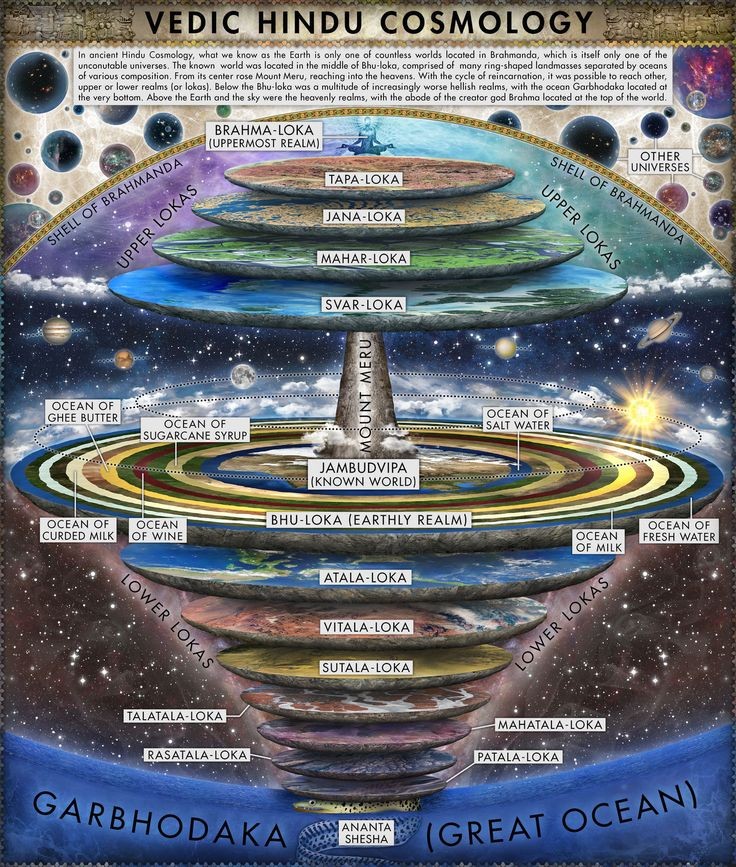
The 14 Lokas: Hidden Dimensions
Hindu scriptures describe 14 Lokas or realms of existence:
- 7 higher worlds (Swarga Lokas) — spiritual planes, from Bhuloka (Earth) to Satyaloka.
- 7 lower worlds (Patala Lokas) — subtle dimensions, often misunderstood as “hellish.”
These lokas are not places you can fly to in a spaceship. They exist parallel to our reality, invisible to ordinary perception — much like the extra dimensions of string theory that are “curled up” at scales smaller than atoms.
Om: The Primordial String
In Hindu scriptures, creation begins with the primordial sound “Om” — the vibration of the universe itself. The Bhagavad Gita says: “I am the syllable Om.” — Krishna.
This aligns perfectly with string theory’s core idea: the universe’s fundamental essence lies in vibrating strings of energy. Different vibrations create different particles — different “notes” in the cosmic symphony.
Hindu cosmology also describes Vishnu reclining on the cosmic ocean, with the universe emerging from his navel — a poetic image of creation emerging from a boundless, vibrating source.
String theory
Vibrating strings create matter, forces, dimensions.
Hinduism
Om is the cosmic vibration, source of all existence.
Yugas and the Relativity of Time
Hindu scriptures describe time as cyclical, not linear — divided into four yugas (ages):
One complete cycle (Mahayuga) is 4.32 million years. A thousand such cycles make one day of Brahma — 4.32 billion human years.
This resonates with Einstein’s relativity, where time stretches and contracts depending on velocity and gravity. In string theory, time is not absolute — it can behave differently in higher dimensions.
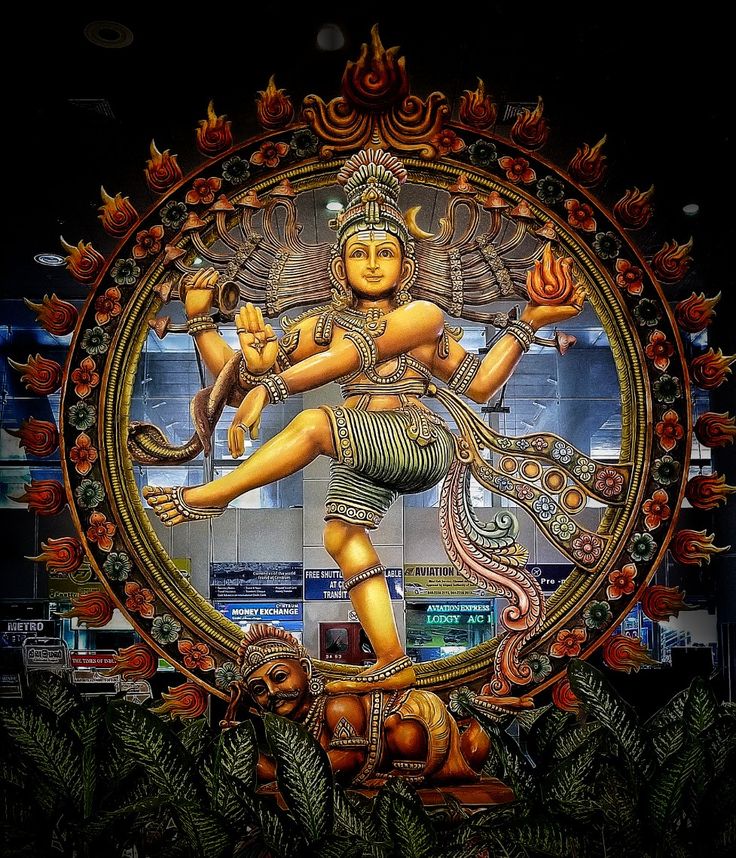
Shiva’s Tandava: The Universe in Motion
The Nataraja form of Shiva performing the Tandava dance symbolizes the eternal cycle of creation, preservation, and destruction. The dance never stops — it is the rhythm of the cosmos.
In string theory, the universe is constantly in motion: strings vibrate, collide, break, and reform. Particles are born and annihilated in an ongoing cosmic dance.
As the physicist Fritjof Capra famously noted: “Modern physics has shown that the rhythm of creation and destruction is not only manifest in the turn of the seasons and in the birth and death of living creatures, but is also the very essence of inorganic matter.”
Bubbles in the Cosmic Ocean
The Vishnu Purana describes Vishnu lying on the cosmic ocean, with countless universes emerging like bubbles from his body. Each universe has its own time, space, and laws — a vision of the multiverse.
String theory also predicts a multiverse — an enormous number of parallel universes, each with different physical constants, arising from the landscape of string theory solutions.
Hindu multiverse
Universes like bubbles from Vishnu.
String multiverse
Countless universes from string theory landscape.
Brahma’s Day: 4.32 Billion Years
The Hindu cosmic calendar is staggering:
- 1 day of Brahma = 4.32 billion human years.
- 1 night of Brahma = another 4.32 billion years.
- Brahma’s full lifespan = 100 divine years ≈ 311 trillion human years.
Modern science estimates the universe’s age at about 13.8 billion years — but string theory allows for universes far older, depending on dimensions. The Hindu numbers hint at a vision of time beyond our current measurements.
Anu, Paramanu, and Vibrating Strings
Ancient texts like the Vaisheshika Sutras discuss anu (atoms) and paramanu (subatomic particles) — the indivisible building blocks of matter. They described these as eternal, indestructible, and constantly in motion.
Today, string theory takes us even deeper: the smallest units are not particles but vibrating strings, far smaller than any subatomic particle. The ancient intuition of a fundamental, dynamic essence resonates beautifully.
Ancient Wisdom Meets Modern Science
Hindu scriptures and string theory, though separated by thousands of years, seem to converge on many ideas about the cosmos. String theory offers a mathematical framework; Hinduism offers a spiritual and philosophical vision.
Is it coincidence, or did ancient sages glimpse dimensions we are only now beginning to model? Perhaps the truth is that science and spirituality are both trying to describe the same reality — one from the outside, one from within.
The dialogue between ancient insight and modern discovery is just beginning. And it’s a conversation open to all of us.
Whether you see it as science, poetry, or prayer — the universe is more wondrous than we can imagine.