

Say no to caste system if you are a real hindu.
In the age of ages, long before our calendars, a great flood was coming. The waters of the ocean were stirring, preparing to swallow the world and end the age.
But on the banks of a sacred river in the ancient land of Dravida (South India), a righteous king named Satyavrata was performing his daily austerities. This king, who would later be known as Vaivasvata Manu, had a heart overflowing with compassion.
One day, as he offered water from his cupped hands, a tiny fish swam into his palm. “O King,” it whispered, its voice filled with urgency, “please save me. The large fish in the river will devour me.”

Manu, moved by its plea, took the small fish and placed it in a jar. By morning, it had outgrown the jar. He moved it to a pot, but it grew still. He moved it to a well, then a pond, then a great lake, and each time the fish grew until it was too large for the waters that held it.
Finally, the king realized this was no ordinary creature. The fish spoke again: “King, I must go to the ocean, but I fear for you.”
“Who are you?” the king asked, bowing low.
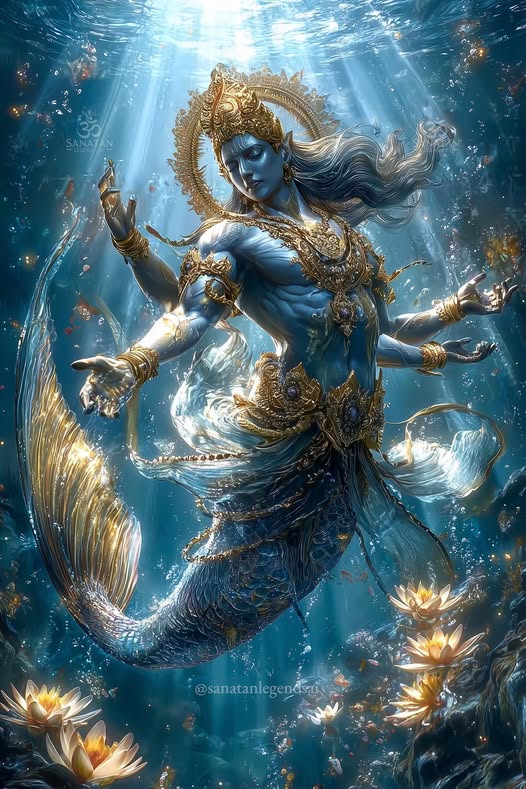
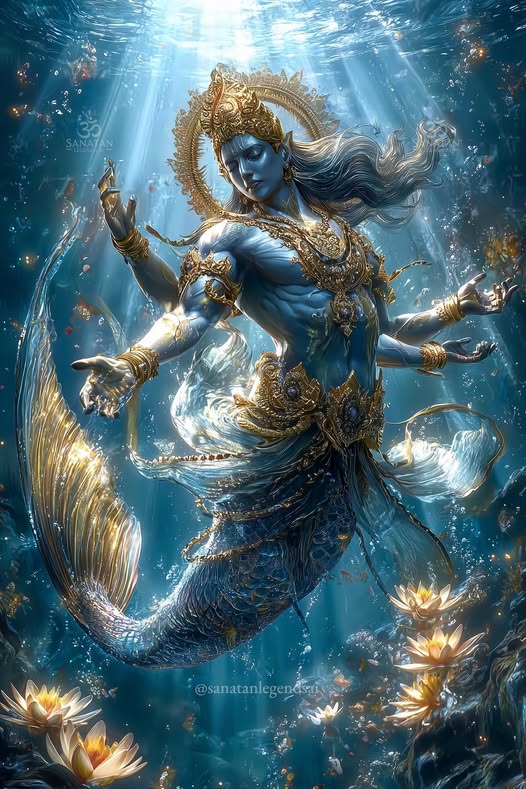
The fish’s form shimmered, and it grew to a colossal, golden size. “I am Vishnu,” it said, its voice resonating with cosmic power. “I have come to save you. In seven days, a pralaya—a great flood—will come and submerge the entire world. All will be dissolved.”
Manu trembled. “My Lord, what must I do?”
Vishnu, in his majestic form as Matsya (the fish), commanded him: “Build a great ship. You are to be the father of the new age, the new Manu. When the flood comes, you will bring onto that ship the Seven Great Sages (the seeds of Wisdom), the seeds of every plant (the seeds of Nature), and a pair of every animal (the seeds of Life).”

Notice, the Lord did not say, “Save only the high-born” or “Save the priests” or “Leave the laborers.” He did not speak of caste. He commanded Manu to save the essence of humanity and nature itself.
The rains came. The oceans rose, and the world was swallowed by a single, dark, raging sea. Manu, the sages, and the seeds of life were tossed on the waves in their sturdy boat.
As he prayed, the great golden Matsya appeared, his horn shining like a beacon in the storm. “Tie your ship to me,” he commanded.
Manu did as he was told. And for an entire age, Lord Vishnu himself, our great savior, pulled their vessel through the darkness, protecting the father of our race.

When the waters finally receded, the ship rested on a high mountain. Manu stepped out onto the new earth. From this one man, and from the wisdom and life he preserved, all of humanity was born again.
This is why we are all called Manava (मानव) or Manushya (मनुष्य) in Sanskrit and Hindi, meaning “Descended from Manu.”
This is why, in Tamil, we are called Manithan (மனிதன்), rooted in “Manam” (mind), just as Manu is the “thinking man.”
This is not just a word. It is a bloodline. It is a sacred truth. It means “We are all children of Manu.”
We are one family. We share one blood.
The Great Deception: Building Walls Where Unity Was Meant To Be
So, if our most foundational story—the story of our very survival, originating from the land of Dravida—is one of absolute unity, where did the walls come from? If we are all one family, descended from one source, who taught us to call our brother “low” and our sister “impure”?
This is the great misconception. The idea that the rigid, birth-based Jati (caste) system is “rooted in Hinduism” by later false gurus and priest,even included in some holy text is the greatest lie told to divide us again our divine lords wishes.
This system, this Jati, is a man-made cage. It was created for power, for control, for “divide and rule.” It has caused untold suffering and injustice.
And to make it work, its creators had to hide the original truth.
The Truth They Hid: Varna (Responsibility, Not Division)
The truth they hid is called Varna.
The original Vedic concept of Varna was never about birth. It was about your role, your responsibility, your function within a healthy society. The Bhagavad Gita is clear: it is based on your guna (aptitude) and karma (actions), not your family name.
The Vedas described society as a single, interdependent body:
- The Brahmins were the head: the thinkers, teachers, and priests—those who guided with wisdom.
- The Kshatriyas were the arms: the protectors, warriors, and leaders—those who defended and governed.
- The Vaishyas were the thighs: the merchants, farmers, and artisans—those who sustained and created wealth.
- The Shudras were the feet: the laborers and service providers—those who formed the essential foundation.
“The idea of caste is the greatest dividing factor and the source of all evil in India… The only way to destroy ‘caste’ is to destroy ‘privilege.’”
Swami Vivekananda
Leave a Reply