

An Essay
God Must Be Crazy
Why do we call actions good when God does them, even if we would condemn them in people?
Picture a ruler who has absolute power. He expects complete obedience, punishes those who resist with disaster, and allows children to die even though he could help. He criticises human violence but calls his own actions just.
If this person lived nearby, you would be afraid of him. If he led your country, you would want him to explain his actions.
But if you imagine him in heaven, suddenly it is wrong to even ask for an explanation.
The title is meant to provoke thought. The real question is serious: why do we call actions good when God does them, even if we would condemn them in people?
Calling God a psychopath is not a medical claim. The real issue is the behaviour: domination, seeming indifference to suffering, and using power without being answerable. These are moral concerns. They deserve more than just being told to submit.
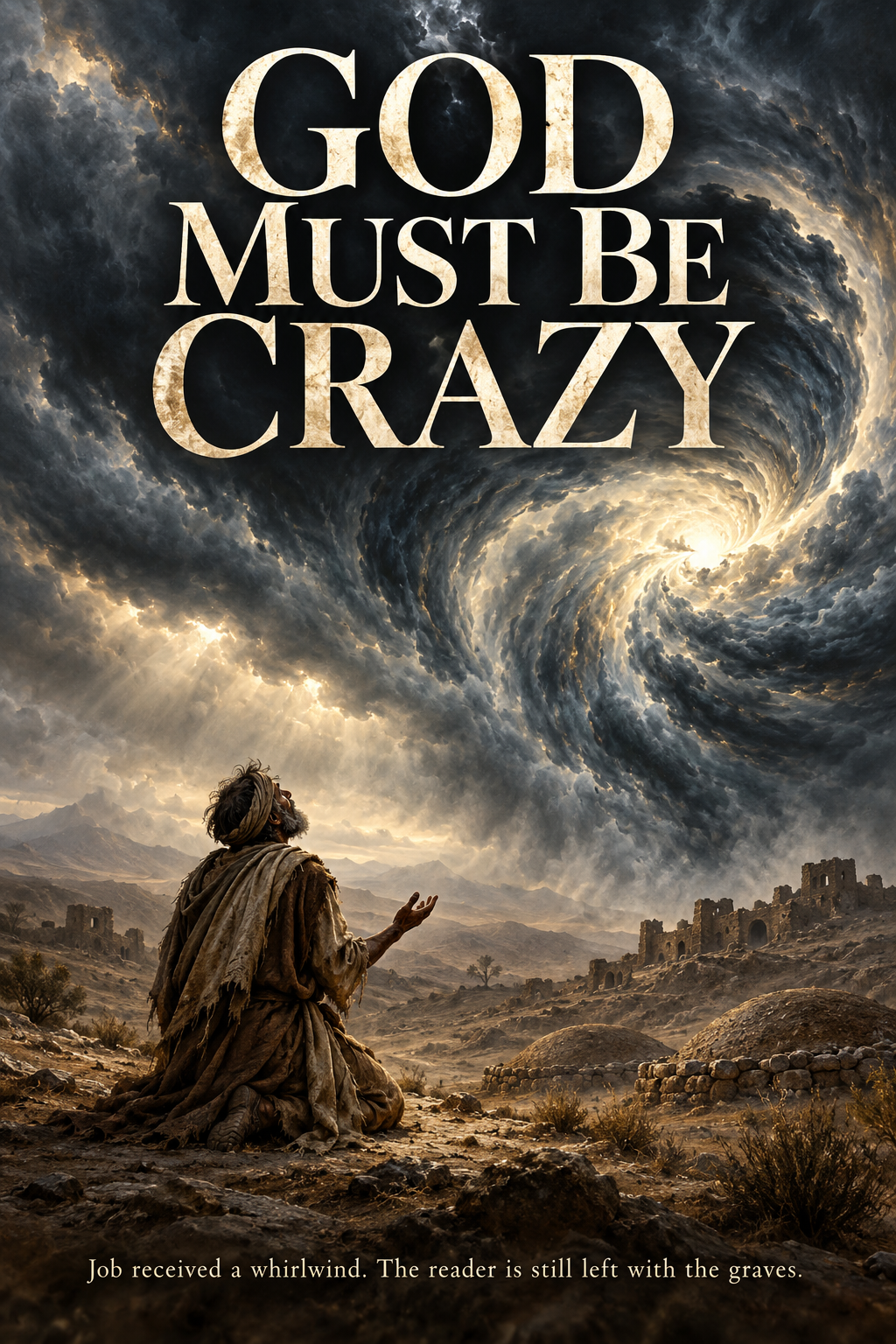
Consider Job
At the start of the story, a heavenly figure questions Job’s motives, suggesting he is faithful only because his life is easy. God allows Job’s wealth and family to be destroyed, and then his health to suffer. Job’s loyalty is tested, but he and others who never agreed to be part of the test pay the price.
In Job 2:3, God admits that Job was attacked “for no reason.”
If God knows everything, he would already know the answer. So who is the suffering supposed to teach? When God finally answers from the whirlwind, he shows Job how vast and complex creation is. Job learns how little he understands, but he is never told about the challenge in heaven that started his suffering.
The answer is powerful writing, but as a moral explanation, it does not address the main problem.
Knowing how to create the stars does not, on its own, explain or justify what happened to a child.
At the end, Job’s wealth is returned and he has seven sons and three daughters. The friends who spoke wrongly about God are corrected, and Job is vindicated, which makes it hard to see the book as just a call for silence. Still, the children who died are not brought back in the story.
The story might seem to suggest that a new family makes up for the loss of the old one. But children cannot be replaced. Finding happiness later does not make a past death right.
Maybe that discomfort is central to the book. If you read Job as a story that shows how simple answers to suffering fall short, it is very powerful. But if you read it as a defence of everything God does, it leaves hard questions with no answers.
The Usual Defence
The usual defence is that God might have reasons we cannot understand.
Maybe so. We do not know everything. But that works both ways. If we cannot understand enough to question God’s goodness, how can we be sure enough to claim it?
A hidden reason could exist, but it is not an explanation we have actually received.
Appealing to human freedom leaves another gap. Human choices can account for much cruelty. They do not, by themselves, explain childhood cancer or an earthquake that buries a sleeping family. Calling these things a test only renews the question: why would perfect wisdom require such a test, and perfect love permit its cost?
None of this shows that God does not exist. Instead, it questions the idea that someone can have unlimited power and perfect goodness while allowing things we would feel morally required to stop.
Believers can challenge harsh images of God. They can see scripture as human stories, shaped by the worries and beliefs of the writers. They can admit that suffering is still a mystery. These responses keep moral questioning alive.
What ends the discussion is saying that whatever God does is good just because God does it.
Maybe asking “Is God crazy?” is not the right question. The tougher question is whether we are willing to keep the true meaning of compassion, even if it makes our beliefs uncomfortable.
Job got a whirlwind as his answer. The reader is still left thinking about the graves.
Thousands of years later, we are still asking why.
❦
An essay on power, suffering, and the questions we are told not to ask.
Leave a Reply