

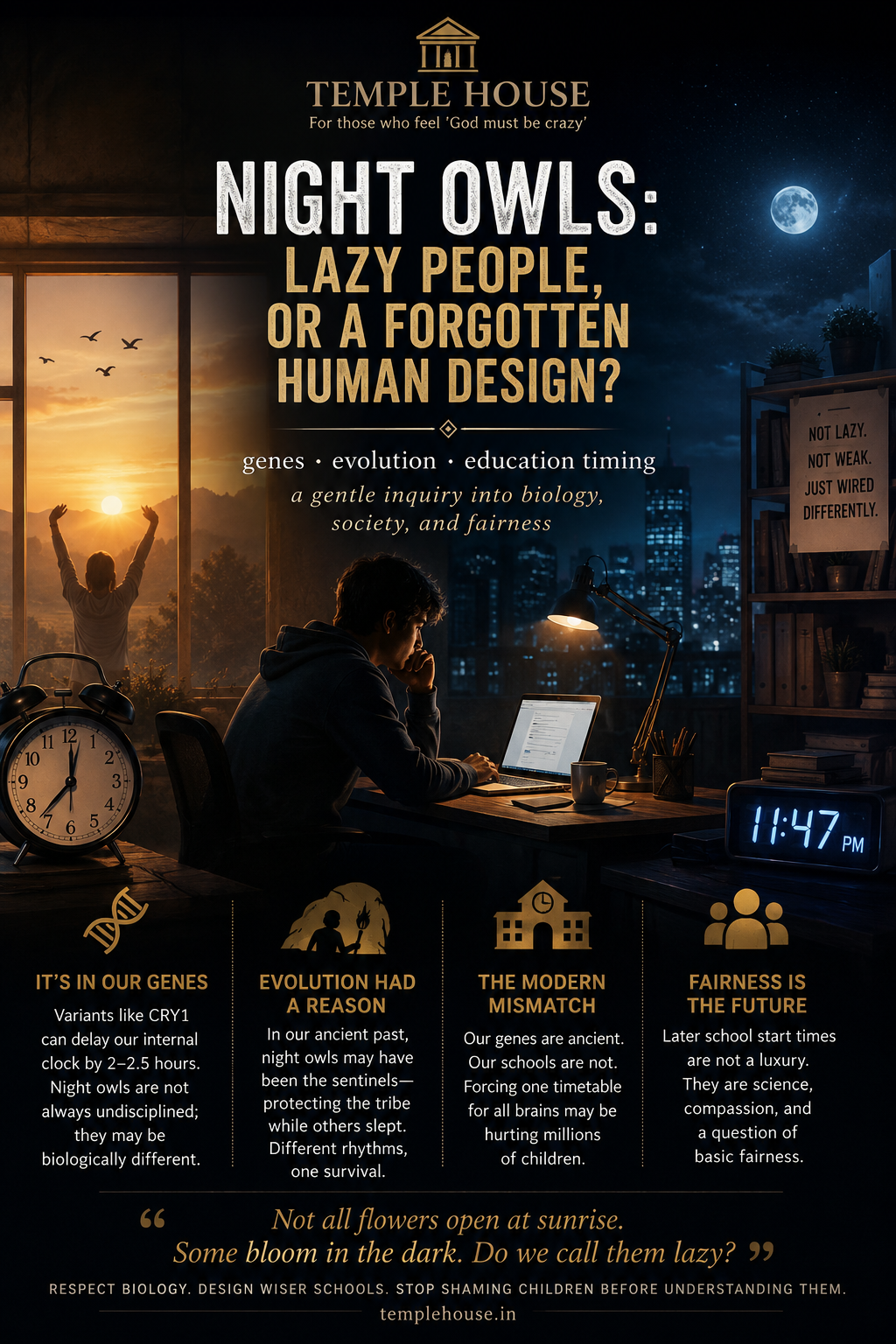
Night Owls:
Lazy People, or a Forgotten Human Design?
“Good boy.”
“Disciplined girl.”
“Future winner.”
And the one who wakes late?
“Lazy.”
“Careless.”
“No ambition.”
But wait.
What if that child is not lazy?
What if the clock inside the body is simply different?
What if society built one timetable for all humans, while nature created many kinds of humans?
1. The hidden clock inside us
Inside every human being, there is a silent clock. It does not hang on the wall. It does not follow school bells. It does not obey office attendance. It lives inside our cells. Science calls it the circadian rhythm — the body’s natural cycle that decides when we feel sleepy, awake, hungry, alert, or tired.
Some people are naturally morning types. Some are evening types. Some are in between. The world calls them early birds and night owls. But maybe these names are too simple. Because genes may play a role in this habit. Researchers have found variants like CRY1 that can slow the body’s internal clock, making some people naturally sleep and wake later.
2. Did evolution make a mistake?
Why would nature create night owls? If early waking is the only correct way, why did evolution preserve late sleepers? Maybe the answer is hidden in our ancient past.
This is known as the sentinel hypothesis. It suggests that different sleep patterns helped human groups stay alert at night. A study of Hadza hunter-gatherers observed night-time vigilance patterns. So maybe the night owl was not a defect. Maybe the night owl was once the guardian of the sleeping tribe.
3. The modern world changed faster than the human body
The problem is not only biology. The problem is mismatch. Our genes are ancient. Our schools are modern. Our offices are industrial. Our exams are timed. Our attendance registers are merciless. A child may be mentally sharp at 10 PM, but school demands alertness at 7:30 AM. Then society says: “You are weak.”
So this is not only a personal problem. It is an educational problem, a public health problem, a fairness problem.
4. Education timing: comfort or justice?
Some will ask: “Should schools change timing just for night owls?” But we must ask better: “Should one biological type control the timetable for every child?” We already accept that children are different. Some learn by reading, some by seeing, some by doing. Then why do we pretend all children wake and learn best at the same time?
Later timing is not a luxury. It is not laziness. It is biology asking us for respect.
5. Is it like a rights movement?
This does not mean night-owl timing is the same legal issue as marriage rights or other civil rights. But the moral pattern is similar. First, society creates a “normal.” Then it punishes everyone outside that norm. Then science and empathy slowly ask: “Was our normal really fair?”
A left-handed child was once forced to write with the right hand. Today we know that was wrong. A night-owl child is still forced to learn with a morning brain. Maybe tomorrow we will know that was also wrong.
6. The bitter fact
The bitter fact is this: We call children lazy when we do not understand their biology. We call them careless when their body clocks are fighting our timetables. We call them undisciplined when the system itself is rigid.
Not every night owl needs special treatment. Not every late sleeper is biologically delayed. Mobile phones, late caffeine intake, gaming, stress, and poor routines can also damage sleep.
But true night owls exist. They are not imaginary. They are not morally weak. They are not failed early birds. They are a minority human rhythm living within a majority-morning world.
Conclusion: Not all flowers open at sunrise
A lotus may open with the morning sun. But some flowers bloom at night. Do we call the night-blooming flower lazy? No. We call it different. Maybe it is time to see human beings the same way.
The goal is not to make everyone sleep late. The goal is not to destroy discipline. The goal is not to excuse bad habits. The goal is simple:
Design wiser schools.
Stop shaming children before understanding them.
Because sometimes the child who sleeps late is not avoiding life. He may simply be waiting for the hour when his mind finally wakes.
With humility, this is for the questioners, the late thinkers, and the children who were called lazy too soon.
Leave a Reply